THE SEED

Passive Folder Project

PassiveFolder_Folding Sequence from Skylar Tibbits on Vimeo.


The Passive Folder is a recent development in the line of programmable matter, 1D folding chain, systems. The Passive Folder maintains the full functionality of its previous ancestors i.e. 3 locking positions of rotation, full programmability/functionality at every node, the ability to construct any given 1D, 2D or 3D geometry from a single 1D input string. However, the Passive Folder aimes at scalability for large-scale assembly and thus attempts to save construction time and cost while eliminating its reliance on electromechanical systems. The Passive Folder relies on human constructability and on-site physical programming (pull & rotate mechanism) to transform between any given geometries. This removes the cost for electronics and high torque motors that struggle to fight excessive moment forces that can lead to unit failure at any point along the chain. The simple pull & rotate mechanism allows anyone to simply program each unit by separating each female-to-female unit, then rotating to any of the 3 locking positions and releasing. Any desired geometry can be written as a string of angles or instructions for the user. By starting at one end and walking along the chain, programming each node, angle sequences are locked in-place, resulting in the overall desired geometry.

The Passive Folder was constructed using:

-Waterjet cut (30) 2′x3′ sheets of white powder coated aluminum

-1800 black rivets

-Each connected with a 4″x4″ black turntable bearing

The Passive Folder was built under the Milli-Biology project in Neil Gershenfeld’s Center for Bits and Atoms, MIT.

Project Team: Neil Gershenfeld, Skylar Tibbits, Erik Demaine, Kenny Cheung, Max Lobovsky, Veronica Emig


http://sjet.wordpress.com/2010/01/11/passive-folder/


Time is on My Side

Cold mailman - Time is of the essence from André Chocron on Vimeo.


A group of unassuming residential towers in ’s Grorud Valley neighborhood have been transformed into the stars of Cold Mailman’s video “Time is of the essence” directed by AndrĂ© Chocron.

Taking full advantage of the density of the towers, Chocron set up multiple cameras at various angles in order to shoot a sequence of time lapse videos from sundown to sunup. What looks like an intricately choreographed light show, is cleverly composited in post-production. Predictably, in the evening residents turned their lights on, and as the evening progressed turned them off. In order to create the dance of lights in similar effect to that of an equalizer, Chocron switches between the illuminated and darkened states in concert with the choreography of the song. The end result is an intriguing audiovisual composition.


http://www.archdaily.com/166889/oslo-towers-dance-for-music-video/


digital architecture laboratory: aggregated porosity


echnical diagram of construction detail
customized joint, laser cut panels, tensile cable net
technical diagram of the joint and panels
1 - u clamp
2 - 0.2mm washer
3 - nut for securing cables
4 - 9mm MDF spacer
5 - nut for securing panels
6 - customized joint plate
7 - bolt for securing panels
8 - laser-cut plywood panel
9 - panel numbering to assist in assembly


the canopy's foundation is a 40x40mm L-section steel frame anchored to a wall, to which a grid of laser-cut plywood pieces
are secured. steel cable mesh is attached to this grid, and custom joints are used to affix the individual wooden hexagonal panels
(also laser-cut) to the mesh, where they can be adjusted by hand and gravity into their desired position.

reappropriating off-the-shelf hardware components, the custom joints designed for the project allow flexibility on all three axes,
when attached via slots cut into the plywood that lie perpendicular to slots on the joint's stainless steel plate.

the design of the canopy itself involved manipulation and refinement in modeling programs. using an orthogonal grid,
the basic L-shape of a structure that could provide shade was curved to build in a bench for seating and then modified
to offer an organic-like form. this original surface grid is then used to generate a hexagonal array of panels,
each diverse in form as determined by the computer model, and each constrained at three of their points but open at three others,
permitting the creation of opening and curves. the largest panels are inset with triangular holes to preserve the continuity of the wooden mesh.

reblogged from Design Boom
(source http://www.designboom.com/weblog/cat/9/view/16324/digital-architecture-laboratory-aggregated-porosity.htm)


"All fixed set patterns are incapable of adaptability or pliability. The truth is outside of all fixed patterns"
Bruce Lee


An architecture as landscape

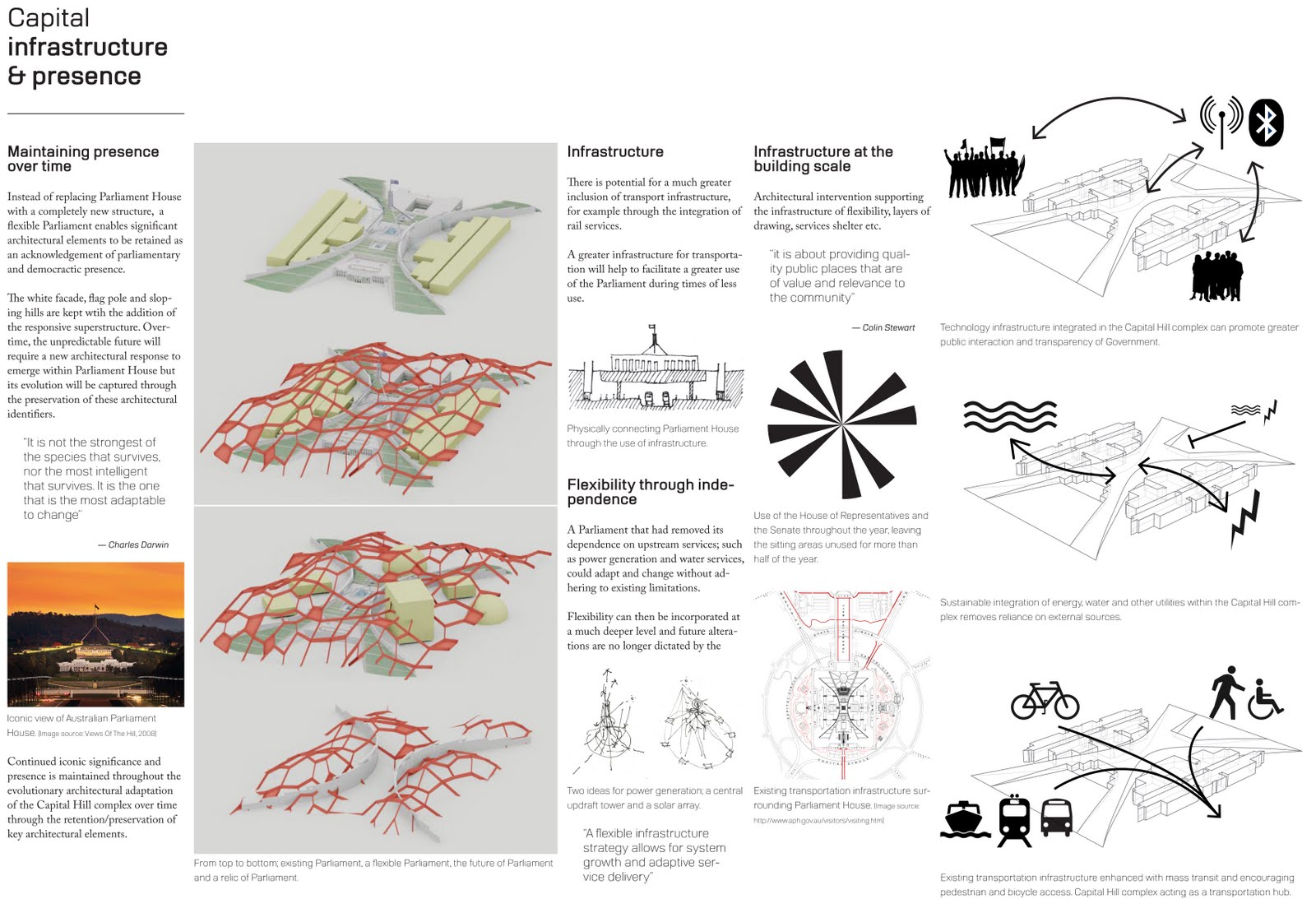
The Capital Hill complex as a landscape which provides for the ecology of parliament.

This landscapes with its amorphic superstructure will adapt and flex to cater for the shifts in spatial and functional demands and provide for both short and long term carrying capacity growth.